
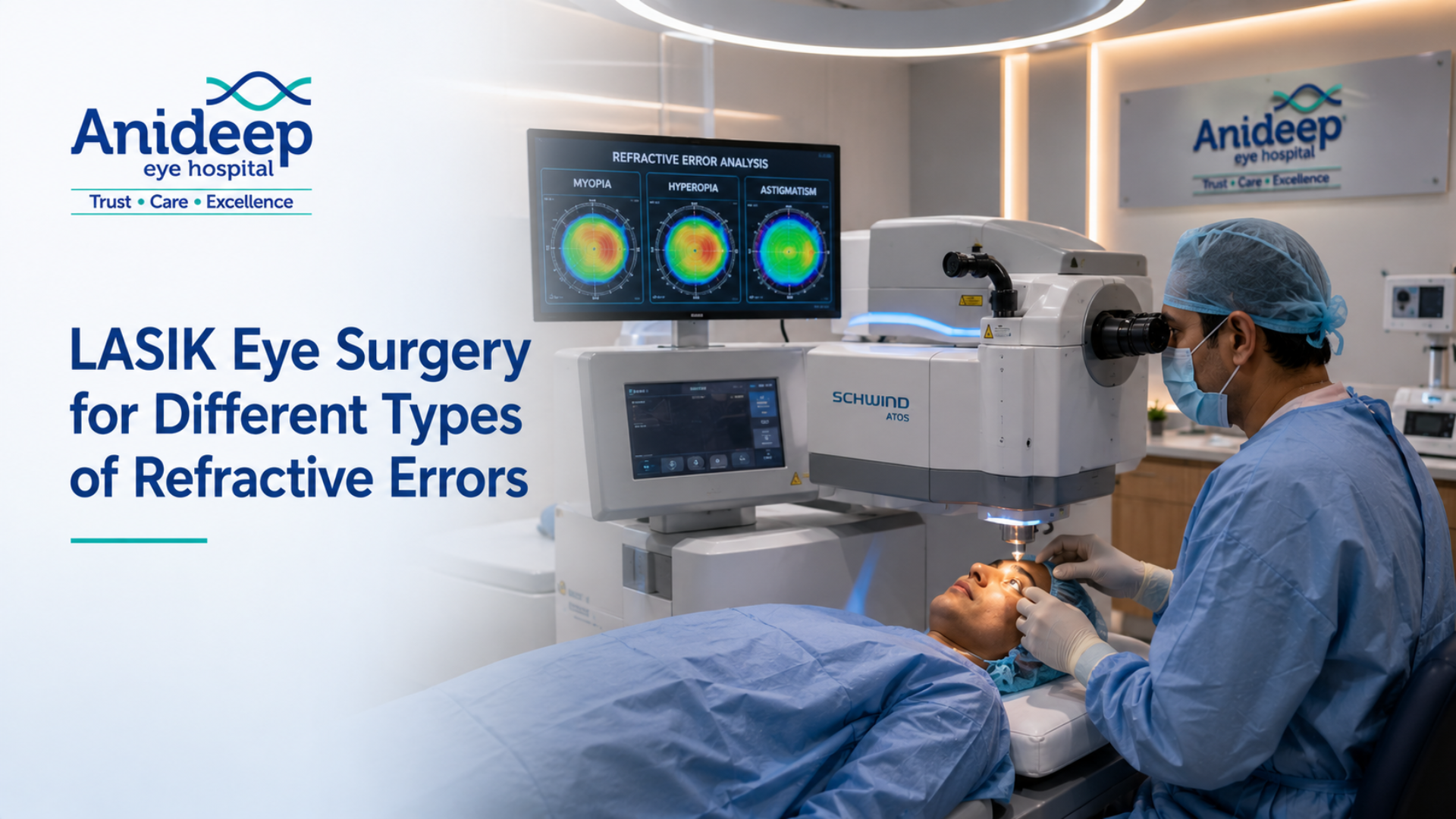
Having clear vision requires light to enter the eye and focus appropriately on the retina. If the shape of the eye does not allow proper focusing of light, objects will be viewed as blurry or not focused. Such cases are referred to as refractive errors.
One way of correcting refractive errors is through wearing glasses or contact lenses, while others may want to go through LASIK eye surgery in order to become less dependent on lenses.
LASIK surgery is one form of laser eye surgery where the cornea is reshaped such that light can focus effectively on the retina. This surgery is not right for everyone and for all types of eyes. An eye exam is needed before undergoing LASIK surgery.
What Are Refractive Errors?
Refractive disorders are conditions in which the structure of the eye does not allow proper focusing of light on the retina. The main types of refractive disorders include:
- Nearsightedness (myopia)
- Farsightedness (hyperopia)
- Astigmatism
- Presbyopia, which is an age-based condition that makes it difficult to focus on nearby objects
The mechanism of action of LASIK surgery and its effectiveness depend on the nature of refractive disorder.
LASIK for Myopia
Myopia, commonly called nearsightedness, makes distant objects appear blurry while objects close by may remain clearer.
In myopia, the eye may be longer than usual or the cornea may focus incoming light in a way that places the image in front of the retina.
LASIK for myopia reshapes the cornea to help light focus more accurately on the retina. The amount of correction possible depends on several factors, including the individual's eye power, corneal thickness, and overall corneal health.
LASIK for Hyperopia
Hyperopia, or farsightedness, can make nearby objects difficult to see clearly. Depending on the degree of hyperopia, distance vision may also be affected.
In this condition, light may focus behind the retina rather than directly on it. LASIK for hyperopia changes the shape of the cornea to improve how light is focused inside the eye.
The suitability of treatment varies between individuals, so an ophthalmologist needs to assess the eyes carefully before recommending laser vision correction.
LASIK for Astigmatism
Astigmatism occurs when the cornea or, in some cases, the lens has an irregular shape. Instead of focusing light evenly, this can cause blurred or distorted vision at different distances.
LASIK for astigmatism works by reshaping the cornea to compensate for the irregular curvature and improve the way light enters the eye.
People with astigmatism may experience blurry vision, eye strain, headaches, or difficulty seeing clearly at certain distances. A comprehensive eye examination can determine the type and degree of astigmatism and whether LASIK may be an appropriate option.
Can LASIK Correct All Refractive Errors?
The procedure of LASIK can rectify myopia, hyperopia, and astigmatism up to certain levels, however, it is not a one-fits-all procedure for all refractive disorders.
Presbyopia is an exception here since it results from natural changes in the eye lens becoming less elastic with age. LASIK cannot prevent the natural aging process. Consequently, before undergoing LASIK, patients should be provided with a thorough discussion concerning their vision expectations both close and far.
Moreover, there are other individual aspects, such as the thickness of the cornea, overall eye health, prescription stability, and others that should be taken into account.
Why Is a Pre-LASIK Eye Examination Important?
Prior to performing vision correction surgery, an LASIK eye specialist should assess the healthiness of the eyes as well as the suitability of the refractive error for correction.
The examination may involve a check on your eye power, corneal topography and thickness, tears, eye pressure, and general eye health. Your medical and eye history can also be included.
This process is necessary since not all patients qualify for LASIK eye surgery. In case there is another procedure or alternative that fits you better, your eye doctor can guide you.
At Anideep Eye Hospital, a comprehensive eye examination can go a long way in assessing your refractive error and general eye health in order to determine suitability for laser vision correction.
What Happens After LASIK?
Following LASIK surgery, a patient’s vision may appear to be blurred temporarily until their eyes heal. Patients can suffer from some side effects such as dry eyes, glare, and light sensitivity as their eyes heal.
It is essential that patients comply with their post-surgery instructions and have follow-up appointments.
Conclusion
There is a possibility of using LASIK surgery for treating various refractive problems like myopia, hyperopia, and astigmatism. The problem will be corrected based on the shape of the cornea.
But the right LASIK eye surgery treatment does not depend only on the spectacle power. Other factors like cornea condition, health of your eyes, prescription stability, age and so on have to be taken into consideration.
In case of wanting to go for laser eye treatment, then make sure that you visit Anideep Eye Hospital for eye checkup. It can help you find out whether you can opt for LASIK.