
- What Is Keratoconus?
- Early Signs of Keratoconus You Should Not Ignore
- What Causes Keratoconus?
- How Is Keratoconus Diagnosed?
- Keratoconus Treatment Options
- 1. Glasses and Contact Lenses
- 2. Corneal Cross-Linking for Keratoconus
- 3. Corneal Ring Segments or Corneal Transplant
- Get Expert Eye Care at Anideep Eye Hospital
Imagine changing your eyeglass prescription every few months, yet your vision never seems completely clear. The reason may be more than a simple change in eyesight. Keratoconus is a progressive eye condition that changes the shape of the cornea and can affect everyday vision. Recognising the early signs and seeking timely care can help protect your eyesight.
Keratoconus can gradually affect activities such as reading, driving, working on digital screens, and recognising faces from a distance. Since the condition may progress differently in each person, regular eye check-ups are essential, especially for teenagers and young adults experiencing frequent vision changes. Early detection allows an eye specialist to recommend suitable keratoconus treatment and monitor changes in corneal health.
What Is Keratoconus?
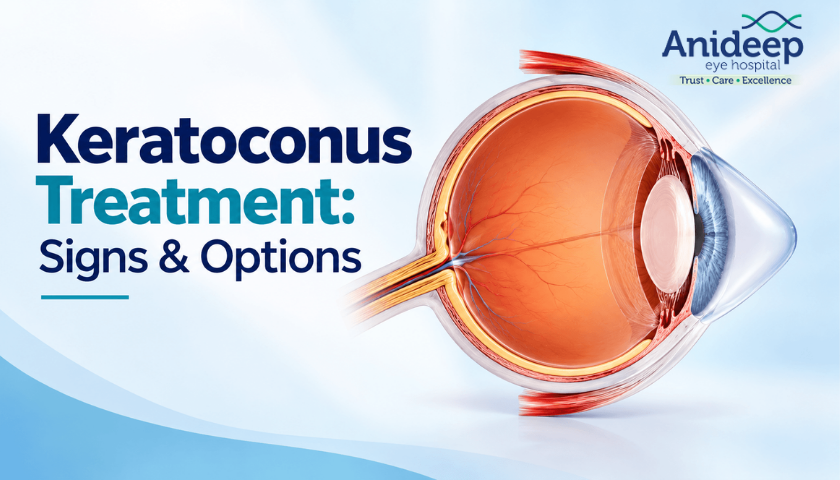
Keratoconus is an eye condition in which the cornea, the transparent front surface of the eye, gradually becomes thinner and bulges outward into a cone-like shape. This irregular shape affects how light enters the eye, causing blurred or distorted vision.
The condition often develops during the teenage years or early adulthood. It can affect both eyes, although its severity may differ between them. Early diagnosis is important because appropriate treatment can help slow or stop its progression.
Early Signs of Keratoconus You Should Not Ignore
Recognising the early signs of keratoconus can help you seek treatment before the condition progresses.
Common keratoconus symptoms include:
- Frequent prescription changes: Your glasses or contact lenses may need updating more often than usual.
- Blurred or distorted vision: Straight lines may appear bent, and objects may look unclear.
- Increased light sensitivity: Bright lights and glare, especially at night, may become uncomfortable.
- Poor night vision: Driving at night may become difficult because of halos or streaks around lights.
- Double vision in one eye: Images may appear doubled or shadowed even when using corrective lenses.
These symptoms can occur with other eye conditions, too. An eye examination is necessary to identify the underlying cause.
What Causes Keratoconus?
The exact causes of keratoconus are not fully understood. However, several factors may increase the risk of developing the condition:
- Genetics: A family history of keratoconus may increase your risk.
- Frequent eye rubbing: Repeated or vigorous rubbing is associated with corneal damage and disease progression.
- Associated conditions: Certain allergic and genetic conditions have been linked to keratoconus.
Avoid rubbing your eyes and seek medical advice for persistent itching or allergies. These steps can support better corneal health.
How Is Keratoconus Diagnosed?
An eye specialist may perform a comprehensive eye examination to assess your vision and corneal health. Corneal topography or tomography creates detailed maps of the cornea, helping identify irregular curvature and early changes. Corneal thickness measurements may also be recommended.
Regular monitoring helps determine whether the condition is progressing and which keratoconus treatment options are appropriate.
Keratoconus Treatment Options
Treatment depends on the severity of the condition, changes in corneal shape, and the patient's visual needs.
1. Glasses and Contact Lenses
In early stages, glasses or soft contact lenses may improve vision. As the cornea becomes more irregular, rigid gas-permeable, hybrid, or scleral contact lenses may provide better visual correction.
2. Corneal Cross-Linking for Keratoconus
Corneal cross-linking for keratoconus (CXL) is a treatment designed to strengthen the cornea and reduce the risk of further progression.
The procedure generally involves applying riboflavin (vitamin B2) drops to the cornea and exposing it to controlled ultraviolet-A light. This process creates additional bonds between collagen fibres, helping the cornea resist further weakening.
Cross-linking primarily aims to stabilise the condition rather than restore normal vision. Glasses or contact lenses may still be needed afterwards. Your ophthalmologist will assess corneal thickness and disease progression before recommending this procedure.
3. Corneal Ring Segments or Corneal Transplant
For selected patients, intracorneal ring segments may help improve corneal shape and visual correction. In advanced cases involving significant scarring or inadequate vision with contact lenses, a corneal transplant may be considered.
The best approach depends on individual examination findings and treatment goals.
Get Expert Eye Care at Anideep Eye Hospital
If you notice persistent blurred vision, frequent prescription changes, or increasing light sensitivity, do not ignore these warning signs. Early evaluation can help identify keratoconus and guide appropriate care.
Anideep Eye Hospital, located in Vile Parle West, Mumbai, provides comprehensive eye care and access to specialist ophthalmologists. If you are looking for an eye hospital in Mumbai or an eye specialist in Mumbai, schedule an eye examination to discuss your symptoms and suitable treatment options.
Book an appointment with Anideep Eye Hospital to take a proactive step towards protecting your vision.
This article is for general educational purposes and does not replace a professional eye examination.